
Tales of the Butlers of Ormonde - Podcasts
In the two short podcasts below, Library Staff Declan Macauley and Damien Brett talk about two tales of the Butlers of Ormonde
Please enjoy the podcasts by clicking on the links below:
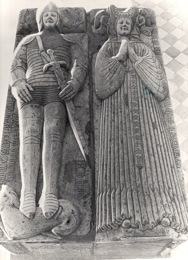
Piers Butler and Margaret Fitzgerald
Two of the most interesting characters to emerge from the late Middle Ages in Kilkenny are Piers Butler and his wife Margaret Butler. Both were characters of strong will and great ambition to overcomer adversities to attain what both would feel was their entitlements and status.
On the surface they were an odd match in that their families two of the great Anglo-Norman dynasts were long rivals. This rivalry had of late become more poisonous as both had taken opposing sides in the English War of the Roses, the Fitzgeralds, the white House of York, the Butlers, the red House of Lancashire. Both families’ fortunes ebbed and flowed depending on who held the throne in England.
Political Marriages between rival families in Ireland however were common as families liked to hedge their bets in the endless power struggles and machinations that characterised this period.
Piers was the son of Sir James Butler, his cousins , James, John and Thomas had being the 5th, 6th, 7th Earls of Ormond. James the 5th Earl had being executed for being a Lancastrian. None of the Earls had any legitimate heirs. Thomas, the 7th Earl who was very wealthy and had two daughters, one of who married Sir William Boleyn. John the 6th Earl had an illegitimate son, James Ormond, later Sir James.
Piers’s father Sir James acted for his cousin, the 7th Earl in Ireland and Piers reasonably would be assumed to be the heir to the Earldom and Thomas’ fortune. With the accession of Henry VII to the English throne and the arrival of the Tudors, the Yorkist cause was lost. Gerald Fitzgerald, the ‘Great Earl’ wasted no time arranging the marriage of his second daughter Margaret to Piers. She was in her early teens, he was 18.
Sir James Butler, Pier’s fatter died in 1487, he made piers his sole heir over his older brothers as well as granting him rights over the lands of Ormond, which he had held for Thomas the 7th Earl. The couple’s rights and privileges were contested from the start. Piers was jailed by his cousin, the illegitimate Sir James Ormond. Margaret’s father Gerald was jailed in the Tower of London for his Yorkist sympathies. Once Gerald was released, the couple’s fortunes improved. It was rumoured that they murdered James, now known as ‘the base’ Butler. Piers got a royal pardon by 1498 and contrary claims by his brothers to his estates were put aside. Margaret rebuilt Gowran Castle. Piers by now was acting in Ireland for the 7th Earl, Thomas as his father had. This was to change in 1515, when Thomas died, immediately, his daughters and heir husbands began to contest Piers’ succession. Unfortunately, this included the Boleyns. In addition Gerald, the Great Earl and Margaret’s father had also died, her brother Gerald was ordered by the Crown to support Thomas’ daughters claims. Piers and Margaret vigorously fought these claims. In 1528, Piers had to accept the lesser title of Earl of Ossory. In 1538, success was finally achieved when he was granted the titles of Earl of Ossory and Ormond. Piers was often known as Piers Rua because of his red hair or as the Red Earl.
Piers and Margaret actively managed their many estates developing many small industries and bringing in ideas and crafts from Europe especially Flanders. They also founded the Kilkenny Grammer School in St. Canice’s Cathedral. In later life Margaret suffered much tragedy. Piers died in 1539 having being uncontested 8th Earl of Ormond for only 18 months. Her family the Fitzgeralds were almost wiped, her brother Gearld died in the Tower of London, her nephew ‘Silken’ Thomas was executed for treason along with many other relatives.
It is some note of the esteem Piers held his wife that she was co-executor of his will along with two of their sons. Their eldest son James became the 9th Earl. He was known as Sean Bacach due to an injury he suffered in battle against ‘Silken’ Thomas Fitzgerald. He died in 1546, rumoured of poison at a banquet in London. He was succeeded by his son Thomas or Black Tom, the 10th Earl.
Margaret is buried in a magnificent tomb in St. Canice’s Cathedral with her husband Piers. This tomb may have been started during their lives. She had always courted controversy and although born a Fitzgearld had always identified with her husband. They had always fought ruthlessly for what they felt was their due. When admonished by a Priest for not preparing for death, she declared it was better for one old woman to suffer the fires of hell than for the Butlers to lose their lands to strangers.

Thomas “Black Tom” Butler 10th Earl of Ormond
Thomas butler was born about 1531 to James Butler 9th Earl of Ormond, and Joan Fitzgerald daughter of the 10th Earl of Desmond. One of seven sons. He was educated at the royal court Henry VIII, with Prince Edward, later Edward VI. The Butlers like so many Irish families had to work hard to keep their influence at court, as they were at a constant disadvantage to the English. A court education was essentially an academy for the nobles of the realm, and Tom like his father before him new the value of this.
He succeeded his father at the 10th Earl of Ormond in 1546, at about the age of 15. His father had died in suspicious circumstances, allegedly from poisoning. On the coronation of Edward VI in 1547, he was made a Knight of the Garter which was uncommon for an Irishman at this time. He served Edward VI with distinction against the Scots at the Battle of Pinkie, an attempt to unite the British and Scottish crowns through marriage.
His name “Black Tom” and his improved reputation at court seems to come from the quelling of an uprising against Queen Mary, who was to marry Philip of Spain. The uprising was led by Sir Thomas Wyatt known as “White Tom” who disapproved of this marriage, fearing the rule of England by Spain. Thomas Butler’s success in helping to suppress this rebellion, seems to have earned him his nickname “Black Tom”. He returned to Ireland in 1554.
The marriage of his parents James and Joan, had led to a passive period between the two waring families of the Butlers and the Fitzgerald’s. Joan’s later rise to Countess of Desmond had cemented this, when she married Gerald Fitzgerald 15th Earl of Desmond. This animosity had lasted for at least four generations, and flared up again upon the death of his mother in 1564.
This would come to ahead at the Battle of Affane (in County Waterford) in 1565. Gerald Fitzgerald had claimed jurisdiction over “the Deise” and crossed into Waterford with his army to claim tribute. Waterford along with Kilkenny, and Tipperary was considered territory of the Earls of Ormond. Thomas lead an army to meet him and they met at the ford of Affane. He defeated the Earl of Desmond, in what is considered the last private pitched battle in Ireland.
Throughout this period Thomas was a loyal and faithful servant to his cousin Queen Elizabeth I. On hearing of this private battle, she was furious, and summoned both Earls to London. Black Tom a favourite at court convinced her that Gerald Fitzgerald was at fault, and he and his brothers were imprisoned in the Tower of London. Black Tom becomes a dominant figure in Ireland in his absence.
Married three times, he had four children, three of which died at a young age. It is recorded that he fathered at least twelve children outside of wedlock. As he spent a lot of time in England, his relationship with Queen Elizabeth I, also lead to many further rumours. He had a mansion built in the Tudor style at Carrick on Suir, where he lived and ran his vast estates from when in Ireland. It is here in 1614 he passed away, having at the age of 83. As he had no legitimate heirs, so his titles passed to his nephew John Butler of Kilcash. In his lifetime he had served and defended the crown to threats in Ireland and England, and also the lands of the Ormond estates. He is buried in St Canice’s Cathedral in Kilkenny city.